THE CARIBBEAN COMMUNITY
Introduction to Global Studies
By: Victòria Ferrando, Andrea Aznar and Claudia Llamas
BRIEF INTRODUCTION – ORGANIZATION OF AMERICAN STATES
The Organization of American States was formed to promote economic, military and cultural cooperation among its members. It brings together all 35 independent states of the Americas. The OAS’s goals are to prevent any outside intervention and to maintain peace between the various states within the continent of America.
The early origin of the organization is found in 1823 following the principles of the U.S. Monroe Doctrine. Actually, The OAS grew out of another international organization: the Pan-American Union. It held a series of nine conferences from 1889 to 1948 in order to reach agreement on various commercial and juridical problems common to the United States and Latin America. After World War II, all the independent nations of the western hemisphere agreed on a formal mutual-defense pact called the Inter-American Treaty of Reciprocal Assistance.
But in 1948 a stronger security system was needed (in the context of the beginning of the Cold War), so the Organization of American States Charter was signed on April 1948, at the Ninth Pan-American Conference held in Bogotá.
The aims of the organization at that time were to strengthen the peace and security of the western hemisphere and to encourage cooperation in economic, social and cultural matters, among others.
Most of the newly independent nations of the Caribbean joined the organization in the 1960s, and in the early 1990s, after the Cold War, the OAS became a leader in observing and monitoring elections to safeguard against fraud and irregularities. In that time the last major holdout, Canada, joined the organization.
Its structure has different levels of administration. The backbone is the General Secretariat and is headed by a secretary-general elected to a five-year term.
The General Assembly holds annual meetings at which member states are represented by their foreign ministers, and it controls the organization’s budget and supervises specialized organizations.
The Permanent Council (composed of an ambassador from each member state) acts as the provisional organ of consultation until all the member states’ ministers of foreign can gather.
Both the General Assembly and the Permanent Council are based in Washington D.C., in the United States.
LIST OF COUNTRIES
Member States
- Antigua and Barbuda
- Bahamas
- Barbados
- Belize
- Dominica
- Grenada
- Guyana
- Haiti
- Jamaica
- Montserrat
- Saint Lucia
- St Kitts and Nevis
- St Vincent and the Grenadines
- Suriname
- Trinidad and Tobago
Associate Members
1. Anguilla
2. Bermuda
3. British Virgin Islands
4. Cayman Islands
5. Turks and Caicos Isl
WHAT % OF THE WORLD POPULATION, THE WORLD GDP OR THE WORL LAND REPRESENTS THAT REGION?
The Caribbean Community covers a total area of 458,480km2. It has a population of 18,482,141, which equals to a 0,24% of the total world population. The GDP of the countries that form CARICOM was in 2018 145,3 billion $. This equals to a 0,18% of the World GDP from the same year.
CHARACTERISTICS
The Caribbean Community (CARICOM) is a group of twenty countries: fifteen Member States and five Associate Members. Stretching from The Bahamas in the north to Suriname and Guyana in South America, CARICOM comprises states that are considered developing countries, and except for Belize, in Central America and Guyana and Suriname in South America, all Members and Associate Members are island states.
CARICOM is based on four main pillars: economic integration; foreign policy coordination;human and social development; and security. The main objectives of this organization are the following:
- to improve standards of living and work;
- the full employment of labor and other factors of production;
- accelerated, coordinated and sustained economic development and convergence;
- expansion of trade and economic relations with Third States;
- enhanced levels of international competitiveness;
- organization for increased production and productivity;
- achievement of a greater measure of economic leverage;
- effectiveness of Member States in dealing with Third States, groups of States and entities of any description;and
- the enhanced coordination of Member States’ foreign and foreign economic policies and enhanced functional cooperation.
The supreme Organ of the Caribbean Community is the Conference of Heads of Government which is formed by the Heads of Government of the Member States. It has the power to determine and provide its policy direction. Moreover,, it is the final authority for the conclusion of Treaties on behalf of the Community and for entering into relationships between the Community and International Organisations and States. They have annual sessions that usually take place at the beginning of july.
The second most important institution of the CARICOM is the Community Council of Ministers. Its main function consists on the strategic planification and coordination in the areas of economic integration, functional cooperation and exterior relations.
These institutions are assisted by five Organs, three “Bodies” and the CARICOM Secretariat. The organs are: The Council for Finance and Planning (COFAP), The Council for Foreign and Community Relations (COFCOR), The Council for Human and Social Development (COHSOD), The Council for National Security and Law Enforcement (CONSLE) and The Council for Trade and Economic Development (COTED). The bodies are The Budget Committee, The Committee of Central Bank Governors and The Legal Affairs Committee.
CARICOM has many different areas of work such as agriculture, education, environment and sustainable development, gender, statistics, foreign policies and community relations, tourism and culture among others.
HISTORY
The Caribbean Community is one of the longest surviving integration movements among countries in development.
First of all, the West Indies Federation was established in 1958. It comprised the ten territories of Antigua and Barbuda, Barbados, Dominica. Grenada, Jamaica, Montserrat, the then St. Kitts-Nevis-Anguilla, Saint Lucia, St. Vincent and Trinidad and Tobago. It only lasted four years, but its end must be seen as the real beginning of what is now the Caricom.
In 1963 the first Heads of Government Conference took place. This Conference was attended by the leaders of Barbados, British Guiana, Jamaica and Trinidad and Tobago. These four leaders spoke clearly about the need for close cooperation with Europe, Africa and Latin America.
Two years later, there was a meeting that focused on the possibility of establishing a Free Trade Area in the Caribbean. In December 1965 the Heads of Government of Antigua and Barbuda, Barbados and British Guiana signed an Agreement to set up the CARIFTA: Caribbean Free Trade Association.
The CARIFTA Agreement came into effect on May 1, 1968. During that year, and the following ones, more than 10 countries joined the Treaty.
Another results from the 1967 Heads of Government Conference were the establishment of the Commonwealth Caribbean Regional Secretariat and the Caribbean Development Bank.
In the Seventh Heads of Government Conference in 1972 the Caribbean leaders decided to transform this Free Trade Association into a Common Market and establish the Caribbean Community of which it would be an integral part.
The original Treaty of Chaguaramas was signed on 4 July 1973 in honour of Norman Washington Manley’s birthday: an advocate of the West Indies Federation and one of Jamaica’s national heroes.
SIMILARITIES AND DIFFERENCES WITHIN THE REGION
Caricom has made great strides, particularly through functional cooperation in education, health, culture and security, etc.
But within the region we also have the Caribbean Single Market Economy (CSME), which is an integrated development strategy foreseen at the 10th Meeting of the Conference of Heads of Government. It has three features:
- Deepening economy integration by advancing beyond a common market
- Widening the membership and therefore expanding the economic mass of the Caricom
- Progressive insertion of the region into the global trading and economic system
MAPS, STATISTICS AND TABLES
Map of CARICOM states

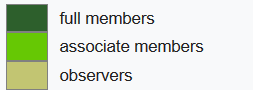
https://commons.wikimedia.org/wiki/File:Location_Caricom.svg
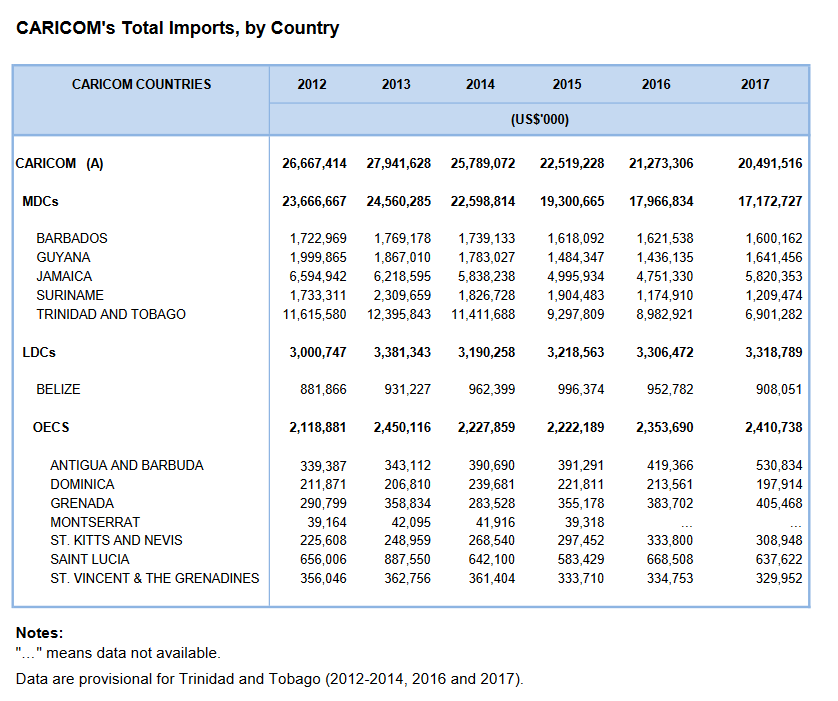
Haz clic para acceder a report3.pdf
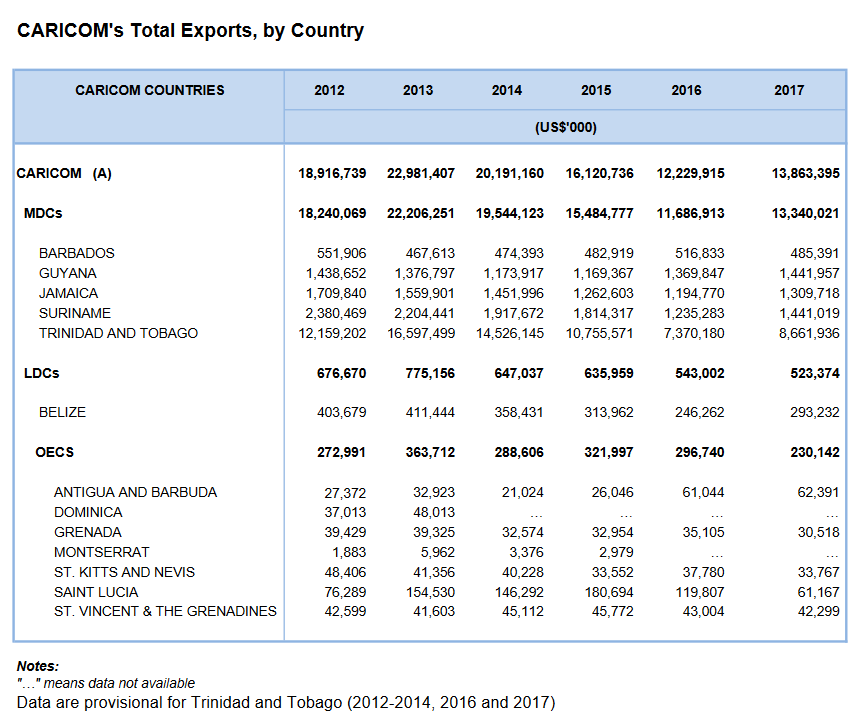
Haz clic para acceder a report4.pdf
As we can see in these two tables above, the CARICOM’s number of imports in dollars is much bigger than the number of exports from 2012 to 2017. This indicates a trade deficit because the commercial balance is negative.
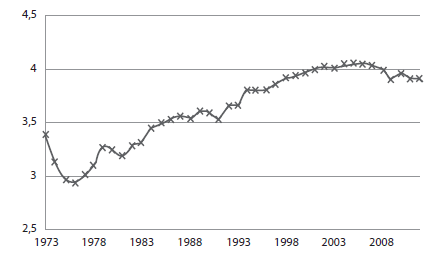
Maximum GDP per capita gap, CARICOM countries. 1973-2012
https://dialnet.unirioja.es/servlet/articulo?codigo=5803784
This graphic shows the evolution of the inequality between the 15 different economies in CARICOM. The further away that result is from the unit, bigger is the gap between the economy that generates the most value added and the economy that generates the least value added.
As we can see, the difference between them has been growing until 2005 and then it started to decrease until 2012. In 2005 the more developed economy
had a gross domestic product per capita gap 4 times higher than the least developed economy in CARICOM.
WHEN THE NAME OF THAT REGION IS USED? WHY? SINCE WHEN?
The name of that region is used to design the original Caribbean Community and Common Market, the name CARICOM is used since the 1st of August of 1973 when took place the Treaty of Charaguamas. It substituted the Caribbean Fee Trade Association (CRIFTA) which was in force from 1965 to 1973. The first four signatures in CARICOM were: Barbados, Jamaica, Guyana and Trinidad and Tobago.
LIST OF REFERENCES
- 5 websites (diff. languages)
https://www.weforum.org/agenda/2018/10/the-80-trillion-world-economy-in-one-chart/
https://www.history.com/topics/westward-expansion/monroe-doctrine
https://www.britannica.com/topic/Organization-of-American-States
- 5 books/chapters of books (diff. languages)
Adrián Bonilla María Salvadora Ortiz, El papel político, económico, social y cultural de la comunidad iberoamericana en un nuevo contexto mundial (2013): Parte II. Las relaciones Unión Europea-América latina y el Caribe a la luz de la I cumbre UE-CELAC. Available:
Haz clic para acceder a papel_iberoamerica.pdf
Lansford, Tom (2015). Caribbean Community and Commonmarket Caricom. Political Handbook of the world 2015. p.1683-1685. CQ Press, 1st edition.
Ian Randle Publishers. (2005). Caricom: our Caribbean community: an introduction. Kingston, Jamaica.
Payne, A. (2008). The political history of Caricom. Kingston; Miami: Ian Randle Publishers.
Seatzu, F. (2015). The Caribbean Community (CARICOM). Latin American and Caribbean International Institutional Law, p.219-230. Springer.
- 5 articles from academic journals (diff. languages)
Research report: Laneydi Martínez Alfonso, “La Comunidad del Caribe (CARICOM) en el contexto de un nuevo regionalismo latinoamericano (2001-2012): cambios, desafíos y oportunidades”. Available: http://biblioteca.clacso.edu.ar/clacso/becas/20131015060449/martinezalfonso.pdf
Germán Héctor González y Stefanía Álvarez (2016). CARICOM: Evaluación de las Asimetrías en el Desarrollo Económico en el Contexto del Proceso de Integración. COMPENDIUM: Cuadernos de Economía y Administración, Vol. 3, Nº. 5, 2016 (Ejemplar dedicado a: Revista Compendium: Cuadernos de Economía y Administración), págs. 13-27. Available: https://dialnet.unirioja.es/servlet/articulo?codigo=5803784
International standards and international trade evidence from Caricom economies. (2012). Retrieved from https://doaj-org.sare.upf.edu/article/d3c7052f3e8946858ea264ba88b8000b
Ruvalcaba, D. M. (2018). La política exterior de las potencias latinoamericanas hacia la Caricom: los casos de Brasil, México, Colombia, Venezuela y Cuba. Colombia Internacional, (96), 87–114. Retrieved from: https://doaj-org.sare.upf.edu/article/1e6c48826ef84c69b35ab92f4eeea308
O’Brien, Derek (2011). CARICOM: Regional Integration in a Post-Colonial World. European Law Journal, Vol. 17, Issue 5 (September 2011), pp. 630-648.
- 5 newspapers articles (diff. languages)
Primera, Maye (July 5, 2013). La comunidad del Caribe en plena crisis de los cuarenta, EL PAÍS
PM Modi announces $14 million grant, $150 million Line of Credit to Caricom. (2019, September 26), THE ECONOMIC TIMES
Caricom mantiene firme posición de no injerencia en Venezuela. (2019, February 26), TELESUR
Caricom llevará a la ONU su reclamo de reparaciones por la esclavitud. (2013, September 20), EL PAÍS
La despenalización de la marihuana y la economía centrarán el encuentro de Caricom (2014, March 9) EL PAÍS
- 5 statistics databases or audiovisual sources
Trade Database (TradSys): http://caricomstats.info/tradsysonline/Home.aspx
UNCTADstat: https://unctadstat.unctad.org/EN/Exploration.html
CSME_MER Framework: http://caricomstats.info/di7web/libraries/aspx/Home.aspx
CARICOM’s databases: http://statistics.caricom.org/databases.html
OECD Data: https://data.oecd.org/
 Título del sitio web
